

What Size Rollator Walker Should I Choose?
Aug 18, 2025
Picking the right rollator walker isn’t just about grabbing the first one you see online. The size you choose can make a huge difference in how comfortable, safe and practical it feels in your daily life. Too tall, and you’ll end up with sore shoulders. Too short, and your back might complain. The good news is, once you know what measurements to look for - like handle height, seat height and frame width - it’s pretty easy to find a rollator that feels like it was made for you.
Handle Height is the First Thing to Check
The handle height is probably the most important measurement. It determines how you stand and walk with your rollator. If the handles are too low, you’ll hunch forward. Too high, and your shoulders will be constantly raised. Both are uncomfortable and can lead to pain over time.
Here’s a quick trick:
(1) Stand up straight with your arms hanging naturally at your sides.
(2) Look at the crease of your wrist (where your palm meets your arm).
(3) That’s where the rollator handles should line up when you grip them.
Most rollators come with adjustable handles, so you don’t have to stress too much. Still, make sure the adjustment range actually fits your height.
Rough guide:
(1) Under 5’3”: Handles should adjust as low as 28"–30".
(2) 5’3”–6’0”: Look for 30"–36".
(3) Over 6’: Go for models that adjust up to 39" or higher.
Set the handles around the height of your wrist crease to find out the handle height (Model: Elenker KLD-9212)
Seat Height is Comfortable When You Rest
If you’re planning to sit on your rollator every now and then (and honestly, that’s one of the perks), the seat height matters just as much as the handles.
When you sit down:
(1) Your feet should be flat on the floor.
(2) Your knees should bend at about a 90-degree angle.
Too high, and your legs will dangle awkwardly. Too low, and it’ll feel like you’re squatting in a child’s chair, which makes standing back up harder.
Seat height guide:
(1) Petite (under 5’3”): 18"–20".
(2) Average height: 21"–23".
(3) Taller folks: 23"–24" or higher.

Average height: 21"–23" (Mode: Elenker HFK-9210KDB)
A lot of brands call this “low seat” or “high seat” versions of the same rollator. So if you find one you like, check if it comes in multiple seat heights.
You might be intereted in the article: How to Choose Right Seat Height for Your Rollator Walker
Frame Width to Fit Through Your Doorways?
This is the part most people don’t think about until their rollator shows up and—surprise—it won’t squeeze through the bathroom door. Standard rollators are usually 22"–24" wide, which works for most homes. But if you have narrower doorways, measure them before you buy.

Standard rollators 22"–24" wide
For bigger models, especially heavy-duty or bariatric rollators, widths can be 25"–30" or more. Great for stability, not so great for tight hallways.

Bariatric Rollators 25"–30" wide or more (Model: Elenker YF-9008A)
Tip: Measure your narrowest doorway first. If it’s less than 24", go for a slimmer rollator.
Wheel Size for Indoor vs. Outdoor Use
Wheels don’t change your personal fit, but they do affect how well the rollator performs in different places.
6-inch wheels: Smoother on tile, hardwood or carpet. Best if you’ll use your rollator mostly indoors.
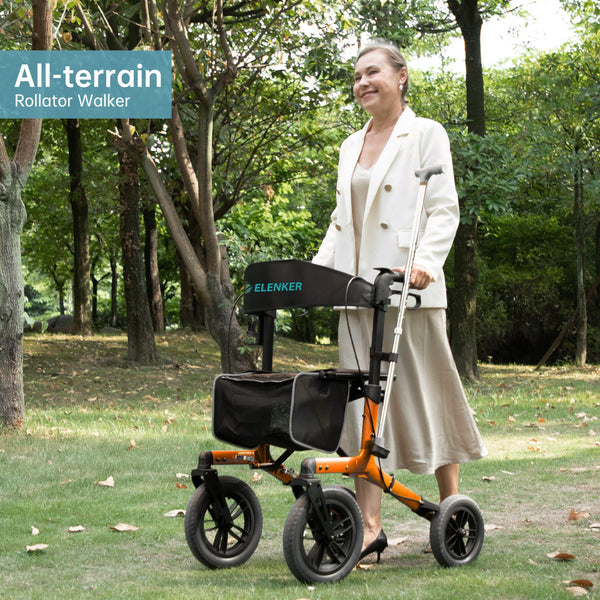
8–10-inch wheels: Roll better on sidewalks, grass or gravel. Ideal if you like to get outside often.
If you want a mix of both, many people go with 8-inch wheels as a “middle ground.”

Elenker MT-8151 upright walker 8" wheels for indoor and outdoor
Weight Capacity for Safety First
Rollators aren’t one size in terms of weight, either. Most standard models support up to 300 lbs. Bariatric rollators can hold 400–500 lbs or more and usually come with wider seats. Always check the specs so you know it’ll safely support you.
How to Measure Yourself for the Perfect Fit
Grab a tape measure and a friend, and you can figure this out in five minutes:
(1) Handle height – Stand tall, arms relaxed. Measure from the floor to the crease of your wrist. That’s your ideal handle height.
(2) Seat height – Sit in a sturdy chair where your feet are flat on the ground. Measure from the floor to the back of your knee. That’s the seat height you should aim for.
(3) Frame width – Measure your narrowest doorway at home. Then check the width of the rollator you’re considering. You want at least an inch of wiggle room.
Everyday Lifestyle Questions to Ask Yourself
Sometimes the right size isn’t just about numbers—it’s about how you’ll use the rollator. Ask yourself:
(1) Do I mostly use it indoors or outdoors?
(2) Will I need to carry it in the car often? (Compact frames are easier to fold and store.)
(3) Do I want to sit and rest frequently? (Go for the right seat height and comfort.)
(4) Am I taller or shorter than average? (Look for adjustable handles with a wide range.)
Petite, Standard and Tall Models
Here’s a quick way to think about it:
(1) Petite rollators: Lower seat (around 18–20"), handles that adjust down to 28". Best for shorter users.
(2) Standard rollators: Seat height around 21–23", handles in the 30–36" range. Works for most average-height folks.
(3) Tall rollators: Higher seat (23–24"+), handles that adjust up to 39". Great for users over 6 feet tall.
Choosing the right size rollator walker comes down to a few simple measurements and knowing how you’ll use it. Focus on handle height, seat height, and frame width, then think about wheel size and weight capacity. With those basics in mind, you’ll be able to find a rollator that actually feels comfortable, fits your home, and supports you wherever you need to go.
A rollator isn’t just a mobility aid—it’s something you’ll use every day. Getting the right fit means you’ll be more likely to use it confidently and comfortably, whether you’re moving around the house, heading out for errands, or strolling through the park.


