

Can I Use a Knee Walker for Any Leg Injury?
Oct 13, 2025
If you’ve ever injured your leg, you know how annoying it is to get around. You try crutches — they hurt your arms. You try hopping — your good leg feels like it’s doing double shifts. Then someone suggests Elenker knee walker, and you think, “Wait, can I use that for any leg injury?” Well, not exactly. Knee walkers are awesome, but they’re not a fix for every situation.
The Right Match: Injuries Below the Knee
A knee walker is perfect for lower leg injuries, meaning anything below your knee. Think of things like:
(1) Foot fractures or surgeries
(2) Ankle sprains or reconstructions
(3) Achilles tendon injuries
(4) Toe fractures or bunion surgeries
Basically, if your foot or ankle is the problem — a knee walker could be your best friend. It lets you rest your injured leg on a padded platform, keeping weight off it, while your other leg does the pushing. You stay mobile, your hands are free for coffee, and you’re not dealing with the underarm torture of crutches.
If your doctor tells you “no weight-bearing” on that leg, a knee walker is often a great solution. You can move around safely while keeping the injured leg completely elevated.
What can an Elenker knee walker do in your daily life?
When a Knee Walker Isn’t a Good Idea
Here’s where it gets tricky — not every leg injury fits the knee walker lifestyle. If your injury is above the knee, it’s a no-go. That includes:
(1) Knee joint injuries or surgeries
(2) Thigh or femur fractures
(3) Hip injuries or replacements
Why? Because the design of a knee walker requires you to bend your knee at about a 90-degree angle and rest it on the pad. If you’re dealing with anything around your knee or higher, that bent position can actually cause pain or interfere with healing.
It’s also not ideal for people who:
(1) Have balance problems
(2) Can’t comfortably bear weight on one leg
(3) Have injuries on both legs
(4) Have poor upper body strength
So while it’s a fantastic mobility aid, it’s not a universal fit.

Elenker MT-9251 knee scooter walker for playing basketball
Comfort and Control Matter
If you’ve ever tried crutches, you know they can feel like a workout. A knee walker, on the other hand, offers more stability and control. Most models come with handlebars, brakes, and adjustable heights, making it easier to roll around confidently.
That said, using one still takes some coordination. You’ll want to start slowly — practice turning, stopping, and rolling on smooth surfaces before hitting uneven ground or tight corners. If you feel wobbly, that’s your sign to adjust your balance or ask a healthcare professional for guidance.
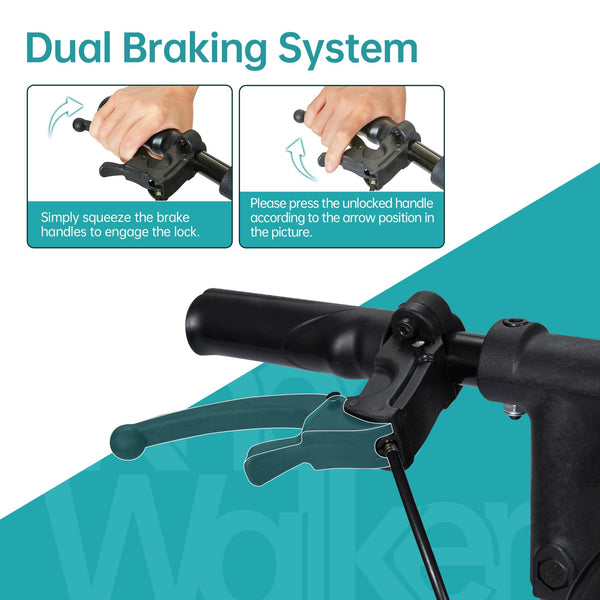
Elenker knee scooter walker with dual braking system
Talk to Your Doctor or Physical Therapist
Before you rent or buy a knee walker, it’s smart to get the green light from your doctor or physical therapist. They can confirm whether your specific injury is suitable for that type of mobility device.
Sometimes, your doctor might recommend alternatives, such as:
(1) Crutches – if you only need short-term support.
(2) A seated scooter – if your balance isn’t great.
(3) A wheelchair – if you can’t safely use one leg to move around.
They might even adjust your knee walker setup — like platform height or handlebar position — to make it safer and more comfortable for you.

With Elenker 2 in 1 rollator walker, you can walk or sit, or you can sit while others push when you get tired with both legs.
The Right Way to Use It
If your doctor says yes to a knee walker, there are a few things to keep in mind:
(1) Adjust it properly. Your knee should rest comfortably on the pad, and your hips should stay level — not tilted to one side.
(2) Use the brakes. They’re there for a reason. Always lock them when standing still.
(3) Watch your speed. It’s tempting to zoom around like it’s a scooter, but sudden stops or sharp turns can cause falls.
(4) Stick to smooth surfaces. Carpets, cracks, and slopes can be tricky. Go slow when you can’t see what’s ahead.
Using it right can make your recovery a lot smoother and safer.
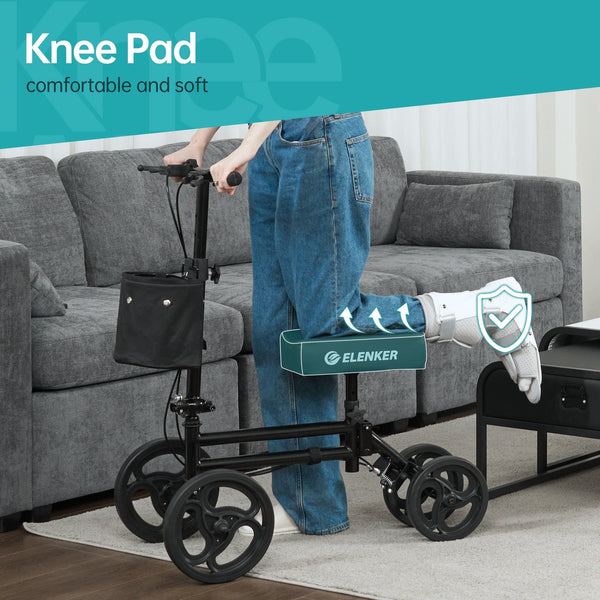
The right position when using a knee scooter walker
When It’s Worth It
For anyone recovering from foot or ankle surgery, a knee walker can seriously make life easier. You can move freely around your house, grab snacks, or even go outside for some fresh air. It gives you independence when you’re stuck in the healing phase — and that mental boost can make a big difference.
Many people say switching from crutches to a knee walker made recovery less stressful. It’s easier on your body and allows you to stay active in small, safe ways.
Quick Recap
(1) Yes, you can use a knee walker for most below-the-knee injuries.
(2) No, you shouldn’t use one for knee, thigh, or hip injuries.
(3) Ask your doctor to confirm it’s safe for your specific condition.
(4) Use it correctly to stay balanced, pain-free, and safe.
So, can you use a knee walker for any leg injury? Not quite. But if your issue is below the knee and your doctor gives the thumbs-up, it can be one of the best mobility tools out there. It helps you stay comfortable, confident and mobile while your body does the hard work of healing.
Just remember — your safety comes first. The right mobility aid isn’t just about moving; it’s about recovering the smart way.


