

When Is a Standard Walker Safer Than a Rollator Walker?
Nov 28, 2025
Walking with the right mobility aid can make a huge difference in safety and comfort. Rollator walkers are fantastic for many people—they glide, they have brakes, seats and storage—but they aren’t always the safest choice for everyone or every situation.
Sometimes, a standard walker actually offers better stability and peace of mind. Let’s talk about when that’s the case.
1. Maximum Stability for Low Balance Users
If you have very limited balance or strength, a standard walker can feel like a security blanket. Why? Because it doesn’t move unless you lift it.
🗹 No rolling wheels means no chance of moving too fast or sliding unexpectedly.
🗹 You can lean on all four legs evenly without worrying about braking or steering.
🗹 For people recovering from surgery, dealing with vertigo, or just feeling wobbly, that extra stability can be a real lifesaver.
Rollators are great for smooth, flat surfaces, but the moving wheels can sometimes make unsteady users feel off-balance - especially indoors on slippery floors or outdoors on uneven paths.

2. Tight Spaces Are Easier to Navigate
Rollators are wider and designed for smoother gliding. That’s perfect for hallways and outdoor walks, but what if you’re in a narrow bathroom, small kitchen, or crowded elevator?
🗹 Standard walkers can be lifted and turned more easily.
🗹 No need to worry about wheels hitting walls or furniture.
🗹 Short turns, pivots and tiny spaces are easier with a walker that stays put unless you lift it.
In spaces where precision matters more than speed, a standard walker wins hands down.

However, if you have better balance, there’s also a 3-wheel rollator walker for you.

Elenker 3 wheels rollator walker for narrow space
3. Uneven, Slippery or Soft Surfaces
Not all walking happens on smooth pavement or carpet. Sidewalk cracks, gravel, sand and ice are tricky surfaces.
🗹 Rollator wheels sometimes can slip, sink or get stuck.
🗹 A standard walker, with its stationary legs and non-slip rubber tips, offers predictable, stable support.
🗹 You can plant it firmly and take your time, instead of hoping the wheels don’t skid.
For anyone who regularly navigates challenging terrain, a standard walker may actually reduce the risk of falls.
However, if you have good balance, a rollator walker with a seat can still be a good option for uneven or slippery surfaces.

4. Simplicity Matters for Some Users
Rollators come with brakes, seats, and sometimes storage baskets. While those features are useful, they require a certain level of coordination and strength.
🗹 Users with cognitive challenges, poor motor control, or slow reaction times may find rollators tricky.
🗹 Controlling hand brakes while walking, steering, and managing a seat can be overwhelming.
🗹 Standard walkers are simple: lift, move, set down, repeat. No extra steps, no surprises.
Sometimes simple is safer, especially for users who just need steady support without extra moving parts.
However, if you use a rollator walker regularly, you’ll develop muscle memory and be able to operate it normally, as it isn’t complicated to use.
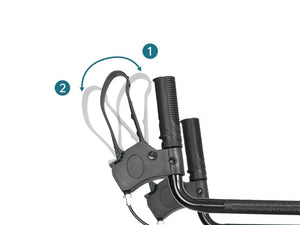
Upright Walkers' Dual Brakes: (1) squeeze to slow down and (2) press down to lock the wheels

Rollator Walkers' Dual Brakes: (1) squeeze to slow down and (2) press down to lock the wheels
5. Lightweight or Petite Users May Benefit More
Some very small or frail individuals may find rollators too tall or heavy to handle comfortably.
🗹 Pushing a rollator can require more strength than lifting a lightweight standard walker.
🗹 Short users might feel like they’re constantly leaning forward or stretching to reach handles.
🗹 Standard walkers can be adjusted for height and are easier to control in these cases.
For smaller users, the predictability and lightness of a traditional walker may be safer than the gliding motion of a rollator.
There are also lightweight Elenker rollator walkers for smaller users.

Elenker dual-brake lightweight upright walker (HFK-9240) weighs only 24 lbs.
6. Short Distances and Indoor Use
If you’re just moving around the house or apartment, rolling all the way with a rollator might be overkill.
🗹 Short walks are often safer and easier with a standard walker.
🗹 You don’t have to worry about brakes or maneuvering around furniture wheels-first.
🗹 Standard walkers also fit neatly in corners and closets when not in use.
For indoor mobility over short distances, a traditional walker can provide peace of mind without extra complexity.

Elenker rollator walker can be folded easily and fits neatly in corners and closets when not in use.
7. Less Maintenance, More Predictability
Rollators have more moving parts - wheels, brakes, seats and sometimes suspension systems.
🗹 If something isn’t adjusted properly, it can affect safety.
🗹 A standard walker is simple, durable and virtually maintenance-free.
🗹 No chance of wheels slipping, brakes failing or seats giving way unexpectedly.
Predictability is a huge safety factor. Knowing that your walker will behave exactly as expected can prevent trips and falls.
This is something a rollator walker cannot match.
8. Posture and Body Mechanics
While rollators encourage upright posture in many users, some may struggle to control their speed or lean forward too much.
🗹 Standard walkers, because they are stationary, allow a user to control every movement deliberately.
🗹 Users can move slowly, plant the walker firmly, and take each step carefully.
🗹 For those with joint pain, fatigue or limited coordination, that controlled movement reduces strain and fall risk.
Sometimes slower, controlled steps are safer than gliding forward too quickly.

9. Confidence Plays a Role
Safety isn’t just about equipment—it’s about how confident you feel using it.
🗹 If a rollator feels intimidating, wobbly, or hard to control, the user may avoid it or use it incorrectly.
🗹 A standard walker is simple and predictable, which can help users move more confidently and safely.
🗹 Confidence leads to better posture, smoother steps and fewer accidents.
When to Choose a Standard Walker
In short, a standard walker may be safer when:
🗹 You need maximum stability rather than smooth motion.
🗹 You navigate tight or confined spaces.
🗹 You walk on uneven, slippery or soft surfaces.
🗹 You prefer simple, low-maintenance equipment.
🗹 You are small, frail or have limited strength or coordination.
🗹 You mainly move short distances indoors.
Rollators are excellent for long walks, outdoor use and users who can handle hand brakes and steering. But for some people and certain conditions, sticking with a traditional walker can be the safer choice.
Both types of walkers have their place. Safety isn’t just about features—it’s about matching the device to the user’s abilities and environment. A standard walker can provide the predictable, stable support some users need, making every step feel safer, simpler and more controlled.
Choosing the right walker is about knowing your own balance, strength, and environment, not just the latest features. Sometimes, the classic approach really is the most secure one.
You might want to read more about: cane vs. walker (no wheels) vs. walker (2 wheels) vs. 3-wheel rollator vs. 4-wheel regular rollator vs. 4-wheel upright rollator vs. 2-in-1 rollator (combo) vs. knee walker (scooter)


