

Can Rollators Handle Uneven Ground or Small Curbs?
Aug 04, 2025
You've got a rollator walker and you're ready to take it out for a walk - but the sidewalk's cracked, the park path is full of gravel, and there’s a curb at every corner. You might be wondering, Can this thing handle it? Good question. Rollators are great indoors, but how they perform outdoors - on uneven ground or curbs - depends on a few key things.
Not All Wheels Are Built the Same
One of the biggest things that affects how a rollator handles bumps and curbs is the wheel size. Small wheels might be fine in your kitchen, but they’re not so happy on grass, gravel, or uneven pavement.
Small wheels (6–8 inches): Common on basic models. Great indoors, but outside? Not so much.
Large wheels (10–12 inches): Better grip, more stability, and less chance of getting stuck on pebbles or sidewalk cracks.
If you’re planning to use your rollator outdoors regularly, bigger wheels are worth it.
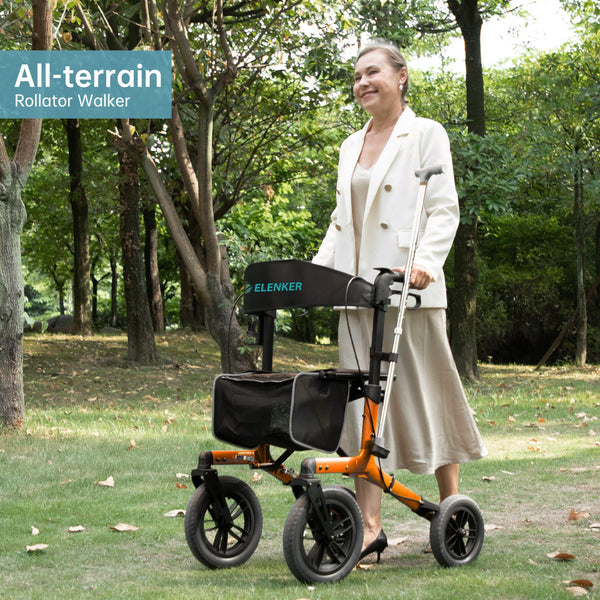
Elenker rollator walker with large wheels
Dealing With Uneven Ground
Sidewalks aren’t always smooth. Grass, dirt paths, brick walkways - they can all make your rollator feel a bit wobbly if it’s not designed for that.
Here’s what helps on uneven terrain:
All-terrain wheels: Think thick, wide tires that don’t sink into grass or get caught in cracks.
Rubber or air-filled tires: These absorb shocks better than hard plastic.
Stable frame: A rollator with a solid build won’t rattle as much or feel like it’s about to tip.
If you’re walking on cobblestones or loose gravel, standard rollators can get stuck. You might end up lifting it slightly or struggling to keep it steady. Not ideal.

Elenker rollator with shock absorber
What About Small Curbs?
Let’s say you’re crossing the street and there’s a 2-inch curb. Can your rollator handle it?
The answer: sometimes—with a little help.
Many rollators aren’t designed to roll straight over a curb. But some models come with a curb assist pedal—a small lever near the back wheels. Step on it, press down, and the front wheels tilt up just enough to get over.

Elenker YF-9007B rollator walker with curb assist pedal
If yours doesn’t have one, you’ll need to:
1. Lock the brakes.
2. Gently tip the rollator back using the handles (like tilting a stroller).
3. Lift the front wheels over the curb.
4. Roll the rest up.
Not difficult, but it takes some getting used to.
Brakes Matter Too
When you’re dealing with uneven ground or curbs, brakes are your best friend. Good brakes keep your rollator from rolling away while you’re trying to step up or down.
Look for rollators with:
(1) Loop-style hand brakes (easy to squeeze)
(2) Brake locks (so it stays put while you rest or lift it)
(3) Strong grip tires (for better traction)
It’s especially important on slopes or if you're trying to park on gravel or dirt. A rollator that doesn’t stay still is more of a hazard than a help.
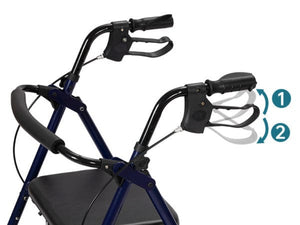
Some Elenker dual brakes: (1) squeeze to slow down and (2) press down to lock the wheels
Are All-Terrain Rollators Worth It?
If you live in a neighborhood with lots of uneven sidewalks, like to go to the park, or just want to feel confident outdoors, an all-terrain rollator might be the way to go.
Here’s what they usually include:
(1) Big wheels (10”+)
(2) Wide tire treads
(3) Sturdy frame for outdoor use
(4) Curb assist pedal
(5) Sometimes shock absorption
One popular option is the Elenker All-Terrain Rollator. It’s got big front wheels, a comfy seat, and a strong frame—perfect if you like to stay active but want something stable.

Elener rollator walker wheels with non-slip tread pattern
Test It Where You Walk Most
If you're buying a rollator for the first time, think about where you walk most often.
(1) If it’s indoor malls, smooth pavement, or tile floors, standard models are fine.
(2) If it’s parks, gravel trails, or cracked sidewalks, you’ll want something beefier.
Still not sure? Bring the rollator on a “test walk” around your block and see how it handles curbs, slopes and rough spots.
Things That Help Outdoors:
Here’s a quick checklist if you want a rollator that can handle real-world walking:
✅ 10-inch wheels or bigger
✅ Curb assist pedal
✅ Strong frame, not too lightweight
✅ Textured tires for traction
✅ Easy-to-use brakes
✅ Optional seat and backrest for breaks
Elenker rollator walker for indoor and outdoor
So rollators can handle uneven ground or small curbs with the right features.
While some models struggle outdoors, others are built to handle bumps, dips and daily challenges without slowing you down.
If walking safely and confidently outside is your goal, a rollator with larger wheels, strong brakes, and maybe even a curb assist feature can make your walks smoother and more enjoyable.
No need to tiptoe around sidewalks or avoid your favorite park path - just pick the right rollator, and you’re good to go.


